The 18th Sir Zelman Cowen Oration, 15th April 2026
Professor David Kilcullen, UNSW Canberra
Australian Institute of International Affairs, Melbourne
My theme for tonight is ‘Australia Resilient, in a Fragile World Order.’ Let me start with the second part first.
A Fragile World Order
As a professor of war studies at UNSW Canberra, I talk with lots of students, participate in public discussions and get emails and calls from members of the public all over Australia and other countries. Most people I speak with recognise intuitively that something’s shifting in the world: assumptions that underpinned our understanding of how things work, for a generation or more, no longer hold.
There are a few ways to conceptualise what’s happening.
I’ve been writing about this for a decade or so, and in my work I tend to frame it as an accelerating transition to multipolarity: a shift in the global system—as US power declines relative to the rest of the world in general, and China in particular—away from a unipolar order with one broadly benevolent, mostly competent great power, the United States, toward a multipolar system of competing regional spheres of influence, mercantilist blocs and super-empowered corporate and private actors.
I say ‘broadly benevolent’ not just because Australia and the US are close allies, but because during their period of unipolar dominance Americans showed an unprecedented inclusiveness, a willingness to bring others along, to tolerate and even finance the rise of rivals, a readiness to bind themselves into an International Rules-Based Order (IRBO), to adopt self-imposed limits on their power, that it’s hard to imagine any other great power accepting, let alone voluntarily inflicting on itself.
Many Americans understandably chafed at this, especially those who saw themselves as disenfranchised by mass migration, who lost their jobs through de-industrialisation or were disadvantaged by globalisation, though the US as a nation—and especially America’s financial, cultural and governing elites—benefited enormously from it.
Throughout this unipolar period America’s adversaries—communist China, authoritarian Russia, theocratic Iran, the hereditary tyranny of North Korea, a series of mostly-Muslim extremist movements—worked to undermine it. In the end, though, it was US overreach after 9/11—the chaos unleashed by the Global War On Terror and in particular the Iraq War—plus the Global Financial Crisis, that fostered a populist, anti-globalist uprising on both right and left in US politics.
Donald Trump emerged ten years ago, in 2016, as the figurehead of this movement. He was such a norm-destroying shock to the system that his opponents themselves began to throw out one norm after another to oppose him and, in the process, did almost as much damage to US credibility as Trump himself. In a way that was hard to articulate but nonetheless real, the COVID pandemic, the killing of George Floyd, BLM, the Antifa riots, the disputed 2020 election, the January 6th Capitol uprising, the fiasco in Afghanistan and the wars in Ukraine and Gaza—all of which happened between March 2020 and October 2023—marked the end of an era: US geopolitical decline seemed to be accelerating while its internal cohesion eroded.
I’m strictly non-partisan but, as a close observer of US politics during the two decades I’ve lived there, I have reluctantly been forced to the view that American political norms are now so thoroughly broken, both parties so decisively discredited in their opponents’ eyes, that whoever Trump’s successor turns out to be in January 2029, a quick return to stability is just not on the cards. This internal fracturing makes it difficult, in turn, for the US to act as ‘leader of the free world’, ‘indispensable nation’ in the international community, or whatever your preferred term might be, even if others in the western alliance were to forgive and forget today’s erratic behaviour.
So, if you liked the US-led, rules-based international order, I have bad news: it’s gone, and it’s probably not coming back.
Canadian Prime Minister Mark Carney, at Davos in January, spoke to that sense of a permanent shift when he said that ‘for decades, countries like Canada prospered under what we called the rules-based international order…American hegemony, in particular, helped provide public goods, open sea lanes, a stable financial system, collective security and support for frameworks for resolving disputes…This bargain no longer works. Let me be direct. We are in the midst of a rupture, not a transition.’
Russian strategists including Vladimir Putin have spoken repeatedly and welcomingly of transition to a multipolar world, calling the US-led order unfair, a zero-sum system where the US arrogated to itself and its friends the title of ‘international community’ and treated other countries as second-class at best, ‘rogue states’ at worst. Putin and others claim that Russia seeks not to supplant the US as hegemon, but to replace that unipolar system with a multipolar one of cooperation among equal and independent regional and civilisational blocs. If you want to know how that works out in practice, you can ask Ukrainians, Georgians, citizens of the Baltic states, Scandinavia and Central Asia, not to mention opponents of Putin’s partner Bashar al-Assad in Syria, or of his allies in Tehran.
For their part, Chinese theorists—notably Yuan Peng who coined the concept ‘great changes unseen in a century’ after the global financial crisis to describe a shift of world power from west to east, and Yang Jiechi who in 2018 incorporated that term into Chinese Communist Party doctrine—see declining US power, fracturing western alliances and a series of technological and economic shifts reshaping the world order, with China taking the lead, driving ‘modernisation with Chinese characteristics’ to build a ‘community of common destiny for mankind.’ Again, though, ask Hong Kongers, Uighurs, Tibetans, Taiwanese—or Kenyan truckers, Burmese democracy activists or Vietnamese or Filipino fishermen—how that plays out in practice. China has its own massive inequality, domestic dissent, unrest, regional and generation gaps and is currently conducting a prodigious purge of the People’s Liberation Army. But one of the weirdest aspects of a very weird time in international affairs is that Beijing lately looks like a beacon of stability and competence compared to Washington.
We can argue, I suppose, about how fast a transition needs to be before it becomes a rupture, but recent months have reinforced the rapidity of that shift. Through various actions—imposing politically-weaponised tariffs, pulling out of international institutions, threatening to seize by force Denmark’s self-governing autonomous territory of Greenland, capturing Venezuela’s president and seizing its oil, insulting allied war dead from Afghanistan, threatening NATO—President Trump may be trying to preserve American primacy, but he’s more likely undermining US moral legitimacy and global goodwill. By eroding any lingering impression of US competence and benevolence, making the US look like a predator and himself a global chaos agent, he may be accelerating rather than reversing the decline.
Still, the US is well ahead of its rivals and, barring a world war, we’re unlikely to see them overtake it anytime soon. US Navy Admiral Phil Davidson testified in 2022 that we’re entering a danger period when China will get as close as it ever comes to being able to defeat the US militarily, but will thereafter decline in relative terms for demographic and economic reasons. This timeline has been debated, but it’s influential in Washington DC, fostering the widely-accepted notion of a ‘Davidson Window’ in which the risk of Sino-American war peaks between 2022 and 2027, before diminishing again into the 2030s.
This might be a self-fulfilling prophecy, but that doesn’t make it any less real. In effect, we could be in a danger period where a rising authoritarian revisionist power challenges an increasingly uncertain and erratic incumbent, with the risk of a global war—World War III—peaking in the next decade. For the specific flashpoint of Taiwan, which Xi Jinping has told the PLA to be prepared to invade by 2027, we might be much closer to conflict—less than a year away, perhaps, from a war in which Washington would either have to back down in humiliation or fight and risk a global conflagration.
What does all that mean for Australia?
To state the obvious, Australia is a globally-connected trading nation, the only country that’s also a continent. We cover a huge area of the world’s land and sea surface with a tiny population relative to our size. Australians live on the other side of the globe from our allies and trading partners, with an economy that depends on exporting raw materials and importing energy and manufactured goods to maintain our prosperity. Our people travel and live overseas in their millions, and our businesses operate worldwide. Our society is optimised for efficiency, not redundancy: for a highly connected, just-in-time world where a stable global system ensures we get the things we need when we need them, without having to think too hard about where those things come from and whose navy protects the ships on which they come.
Over generations, Australians have come to outsource certain aspects of our wellbeing to great and powerful friends: first the British Empire, after 1941 the United States then (for a period in the 1990s) the UN, then the US again since 2001. To quote my friend and fellow UNSW professor, the historian Tom Richardson: since the 1850s, we’ve relied on a great ally to do one critical thing, and one thing only, that we can’t do for ourselves: secure the supply chains, shipping routes and international networks on which our way of life depends, the system sometimes called the ‘global commons’.
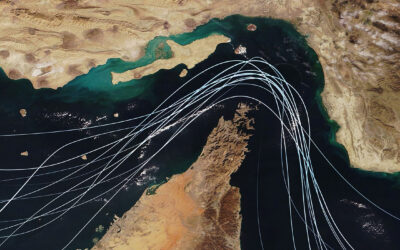
Now in 2026, the US-Israeli attack on Iran—launched without coordination with allies, or even a heads-up as to the massive disruption about to ensue—has thrown that system into disarray, with dire effects on energy, agriculture, manufacturing, mining, computing and more. And the country now calling for calm, exercising restraint and using its influence to broker a ceasefire in order to reopen the global system is Communist China.
Our connectedness means that Australia cannot be secure in an unstable global system, a system that—as a regional power at the southern end of the Pacific and Indian oceans—we lack the capacity to stabilise by ourselves. Merely defending our territory to deny a physical invasion doesn’t help. As the impending fuel crisis, triggered by the closing of a strait five thousand nautical miles from the nearest Australian port, is about to show everyone, an adversary doesn’t need to breach our borders in order to damage our way of life and coerce us.
As Tom points out, the last six weeks simultaneously validate Australia’s enduring need for a friendly, reliable great power to secure the global commons, and invalidate the US claim to be that great power. If we were now to follow the formula of 1941—when, three weeks after Pearl Harbor, Prime Minister Curtin wrote that ‘without any inhibitions of any kind, I make it quite clear that Australia looks to America, free of any pangs as to our traditional links or kinship with the United Kingdom’—we would unceremoniously dump Washington and turn for protection to Beijing. We’re not going to do that, of course, for reasons that I think are fairly obvious.
In the first place, China’s communist authoritarianism is so different from Australia’s liberal democracy that our political systems are arguably incompatible. In the second, there’s no evidence China can currently replace the United States as guarantor of the global commons. Third, more importantly, China unlike the US doesn’t actually have allies—it has vassals, tributary states and protectorates, and it has transactional relationships with powers strong enough to push back against its coercion, but it doesn’t have friends or partners the way the US had until recently. Finally, and I think decisively, the US and Australia share enduring real-world, hard-power common interests in maintaining a free, open, maritime world order that China—as a continental power, linked by land to many of its trading partners and sources of supply—could, at a pinch, do without.
Still, we clearly live in an increasingly fragile world order, in a dangerous neighbourhood, and if our key security ally (the United States) were ever to go to war with our principal trading partner (China) Australia would be devastated. Whichever side won that war, whether we were invaded or not, the consequences for the Australian people and our way of life would be catastrophic.
Accordingly—and here’s where I want to start moving toward my second theme tonight—I would argue that the organising principle of Australian statecraft, at least for the next generation but arguably for the rest of the century, must be to prevent a war between the US and China. Every policy choice, every action across every domain of national life needs to consider the question ‘does this make war more or less likely?’ and in each case we must act to minimise the risk of war. In some areas, notably defence, that heuristic might make us double down on military deterrence. In others such as trade, technology and some primary industries, we might be better off building leverage by reinforcing our relationship with Beijing. In some areas—power generation, perhaps—we might pursue fully self-reliant energy independence. In other areas we might emphasize deep collaborative, multi-faceted partnerships with our Pacific and Asian neighbours to make our region as a whole harder to push around.
Just as we can’t secure the global commons on our own, we can’t by ourselves prevent a great-power war. But the more agency and influence we develop, regionally and globally, the better our leverage to prevent one. We could do that by engaging influentially with allies and trading partners, hunting in a pack with like-minded neighbours and middle powers, supporting stabilising institutions. Likewise, the greater our national capacity, the harder it is for allies to ignore our interests or for adversaries to discount our ability to defend ourselves. And in the worst case, if war does break out despite our best efforts, the more we can anticipate, absorb and withstand the shock of that war, adapt to it and rapidly recover from it, the better off we’ll be. The word for that is ‘resilience.’
Australia Resilient
Resilience is the capacity to prepare for, resist, respond to, and rapidly recover from shocks and disruptions across a spectrum of threats. As a point of comparison, NATO nations have agreed seven baseline resilience requirements including continuity of government and critical services; energy; mass population movement; food and water; mass casualties and health crises; civil communications; and transport. Singapore, Taiwan, the Baltic states, Switzerland and several Scandinavian countries have similar benchmarks, but they also include an additional level termed ‘comprehensive’ or ‘total’ defence. It’s a useful construct for thinking about how military defence—planes, tanks, submarines, missiles—fits into a broader national framework of resilience.
To do that, imagine a pyramid where our security derives from the integrated effects of multiple activities and organisations across a series of layers, each building on the one below. The base of that pyramid is a structured set of national efforts to enhance cohesion, prosperity and government effectiveness. These include agriculture and other forms of food production and distribution, industry and manufacturing, critical technologies, entrepreneurship and innovation, scientific R&D, comprehensive energy security (including fuel production, import, refining and storage, and reliability of the electrical grid) health, education, trade, telecommunications, transport, space policy, supply chain security and, if needed, stockpiling of critical materials. This is the platform on which everything else builds, and it’s fundamental to national well-being. If we want to make the nation more self-reliant, this is the place to start.
The next layer up is national resilience itself, which is about guaranteeing access to communications, financial systems, critical data, the defence industrial base, food, water, energy and mass casualty response. This equates to the NATO resilience baseline we just talked about. It’s a shared responsibility among local, state and commonwealth governments but, ideally, is centrally coordinated and supported by national funding.
The layer above that is territorial or homeland defence which includes border security, critical infrastructure protection, biosecurity, cybersecurity and civil defence. This is largely the responsibility of the Department of Home Affairs, though state and local governments play key roles as do other commonwealth departments such as Defence, along with state emergency services, commonwealth disaster management and response agencies, law enforcement and—crucially—a wide range of civil society organisations.
Traditional military defence is the next layer up. It includes land, air, maritime, cyber, space and information operations by the Australian Defence Force (ADF). This is what most people mean when they say ‘defence’, but it’s only one aspect and, as I hope this description makes clear, not necessarily the most important: if military capabilities don’t rest on a firm base, all those underlying layers, our defence lacks staying power, and our adversaries know it.
At various times during our history, most recently during the War on Terror, ADF capabilities were focused up and out, on making credible contributions to coalition operations outside Australia. This started to change in about 2020, and since the 2021 AUKUS announcement and the 2023 Defence Strategic Review, governments have talked about spending significantly more on this layer of the pyramid. In a self-reliance framework, however, we’d focus ADF capabilities in and down, building on territorial defence and national resilience and contributing to the next layer above military defence, which is countering hybrid and actorless threats.
Countering hybrid and actorless threats—terrorism, pandemics, drug trafficking, people smuggling, the weaponisation of organised crime by hostile states, and so on—involves the intelligence community, special operations forces and law enforcement. It might also involve coalition contributions to global efforts. Finally, at the top of the pyramid is countering grey zone activity, done by the same agencies but focused on detecting and countering sabotage, subversion, espionage, foreign interference, cognitive warfare and political destabilisation.
The higher you go up the pyramid, the smaller the number of people involved, the tighter the control by national authorities, and the greater the role of central government. Higher placement on the pyramid doesn’t imply greater importance, risk, or expenditure—arguably, the lower levels are the most important, especially the foundation layer which is most closely connected to the day-to-day well-being of every Australian. If we were to take a self-reliance approach to national resilience, we would start at the bottom, building our way up to traditional defence only once we’d reinforced the layers below it.
You might argue that this would be prohibitively expensive. It certainly wouldn’t be cheap. For comparison, at last year’s summit in The Hague, NATO countries committed to spend 5% of GDP annually by 2035 on a combination of ‘core defence requirements’ and ‘defence- and security-related spending.’ Under that benchmark, NATO nations are allocating at least 3.5% of GDP to military capability and up to 1.5% for critical infrastructure, defending networks, civil preparedness and resilience, innovation, and the defence industrial base. Australia’s not in NATO, of course, and our needs are different, but let’s run with these numbers for a minute and see where they take us.
The government’s current aspiration is for a defence budget of 2.4% of GDP by 2033. That’s about 44 billion dollars on today’s nominal GDP. US Secretary of War Pete Hegseth has called on Canberra to match NATO’s benchmark of 3.5% military spending, which would be about 64 billion. If we also matched the security-spending benchmark, that additional 1.5%, we’d be spending about another 27.5 billion on territorial defence, homeland security and national resilience. Call it roughly 91 billion dollars in all to meet that 5 percent threshold. As I said, not cheap.
But as I also just said, Australia’s not in NATO. The NATO numbers are a political commitment; there’s no magic to the 5 percent threshold and, in particular, the split between 3.5 percent military and 1.5 percent security is arbitrary. A future Australian government might say something like, ‘we’ll actually spend 6 percent of our GDP—about 110 billion dollars—on the full scope of that comprehensive defence pyramid, but we reserve the right (of course) to allocate spending in accordance with our own national priorities, and we plan to start at the base of the pyramid and build up from there.’ That might mean a focus on agriculture, innovation, R&D, manufacturing, infrastructure, energy independence and supply chain resilience, then a shift to homeland security once we’ve built out the national support base. We might think about expanded military reserves and state- and commonwealth-level emergency services and civil defence to build the personnel to go with those capabilities. Only then would we start spending more on tanks, planes, ships and submarines. That’s one way, though of course not the only way, that a resilient Australia might intersect with our fragile external environment.
There are a couple of critical caveats, though. First, this approach would make a lot of sense if we didn’t also have the urgent upcoming risk of war that we already know about—the Davidson Window, the chance of war over Taiwan or, more likely, the South China Sea, in the next one to five years. When you add that into the mix, you end up with two buckets into which you would need to organise your effort.
The first would be the immediate, near-term task of deterring war if possible, and surviving it if necessary, over the next 1 to 5 years. Obviously enough, there’s no time to buy new capabilities before next year’s peak danger period over Taiwan, so this is actually not a matter of money at all. Instead, it’s about taking stock of what we already have, then organising and mobilising it for deterrence and resilience now. This is what soldiers sometimes call the ‘fight tonight’ issue—and it’s a hugely urgent task that’s not about the budget, but about war plans, operational readiness and building war stocks of ammunition, food, fertiliser, fuel and medical supplies.
The second bucket is the longer-term resilience agenda, building our way up from the bottom of the pyramid, filling gaps and improving self-reliance at each level, then moving to the next. This would be a 20- or 30-year effort, at least—particularly when it comes to strengthening agriculture, diversifying energy sources, improving our agility in innovation and R&D, rebuilding the national manufacturing base, expanding into the high-tech semi-conductor space, the AI and quantum economy, and so on. This will take time, and it would be awesome if we weren’t so far behind on some of these areas, but as the environmentalists say, ‘the best time to plant a tree was 20 years ago; the second-best time is now.’
In the best case, our surge of immediate deterrent effort in the next one to five years gets us over the hump of the Davidson Window, and our parallel push for bottom-up resilience means that, by the time we come back to building out ADF capabilities, we’re in a much stronger, more resilient condition. In the worst case, we end up in a war as early as next April but, at least, we’ve thought about the problem and engaged the Australian people on solving it.
That’s my second caveat: all of this stuff is just what I think. Of course, I do believe it’s broadly correct, otherwise I wouldn’t be putting it forward. But at the end of the day, what technical people like me think about this doesn’t really matter. Not only am I just one strategist among many, but in a parliamentary democracy, technocrats shouldn’t be deciding the way forward. That’s for the elected government, in consultation with the Australian people.
In fact, for something as fundamental as this, I’d argue that National Cabinet—perhaps expanded into a UK World War Two-style war cabinet involving both sides of politics at the federal and state level—needs to take a bipartisan lead. We used to have that system, by the way—in the 1950s and 60s, at the height of the Cold War, Australia had a robust Civil Defence structure and a territorial defence system with national, state, district and local ‘war executive committees’.
You could object that a bipartisan approach would slow things down, resulting in lowest-common-denominator consensus decisions, rather than tackling more difficult and contentious issues. That’s true, but that could be a feature rather than a bug: it would mean no party could push its own narrow agenda, and we’d have to consider all levels of government and both sides of politics to make things happen. Of course, we’d also need a robust, transparent process of public consultation. Government would need to level with the Australian people about the gaps in our resilience and the consequences of leaving them unfilled. Since people’s lives and futures are at stake, buy-in from the community—what we sometimes call ‘social permission’—is not optional here.
Closing thoughts
You’ve been very patient, so let me summarise my argument here and wrap up.
The world order is dramatically more fragile than at any time in recent memory, with an accelerating shift—some say a rupture—away from a stable, unipolar, US-led, rules-based international order. We’re seeing the emergence of spheres of influence, competing blocs, a weakening western alliance, a predatory ‘might makes right’ approach from Washington, and an attempt by Beijing to paint itself as the responsible grown-up in the room. As I’ve suggested, I think the reality is less bad than this framing makes out: the US is still friendly, still powerful, unlikely to be overtaken by adversaries anytime soon. But the rules-based international order we’ve taken for granted for decades, on which our economy, global engagement and defence planning are based, is gone and it’s probably not coming back anytime soon.
This means we need to rely on ourselves more than ever before. We need to become much more resilient against long-term shocks and, in particular, the risk of a major Sino-American war in the next one to five years. I’ve argued that the single organising principle for all Australian statecraft, the underlying logic for every national decision we make over the next generation must be to prevent that war.
That said, just as Australia can’t alone secure the global commons on which we depend, we also can’t by ourselves prevent a war, despite our best efforts. So, we need to build resilience, rapidly, to face the risk that the next great war could be coming sooner rather than later. I’ve suggested that the best way to do that is not just to increase our traditional defence spending but also to broaden our conception of national security to a layered defence model where each layer builds on the one below, and all contribute to comprehensive national security. I’ve put forward a way we might think about funding that, and organising for it.
I’ve also suggested, though, that this needs to be considered in two buckets—an immediate ‘fight tonight’ problem that’s actually not about new spending or capability at all, but rather about taking what we have now and arraying it to maximise our immediate deterrence, and posturing ourselves for resilience if deterrence fails. No need for any new purchases of expensive equipment here: if it’s not in the kitty now, it’s not coming.
The second bucket, building bottom-up resilience for the long term, can start now and will bring immediate benefits in terms of critical stockpiles and the ability to withstand a shock, but it will really come into its own over two to three decades, as we build a more resilient agriculture, innovation, manufacturing, energy and workforce base and improve homeland security on top of that base. It will also, as a not inconsequential side effect, generate lots of jobs and improve the peacetime infrastructure we all use every day. When and if we find ourselves back at the layer of traditional defence, we will be a more robust and cohesive country, better able to employ and prioritise that defence capability.
Finally, please take everything I’ve just said with a big grain of salt, and consider it critically. This is just my opinion, and there are other points of view. We need a robust debate on this and, ultimately, it’s the Australian people and their elected representatives who need to decide the way forward. Academic experts and technical people have a role here, in making sure policy-makers and the public can access a reliable set of facts on which to base those decisions, but at the end of the day, it’s your call. I’d only urge that we get onto it quickly, because time is rapidly running out.