It’s by far the largest air campaign mounted by Israel and one of the largest by the US. The longer the war lasts, the greater the risk that it escalates. For those in Iran at least, there’s no escape.
David Kilcullen, The Australian, 7th March 2026
On the first night of U.S.-Israeli strikes against Iran last weekend, a friend and former colleague in Dubai sent me a video from his rooftop. Emirati air defences had just intercepted an Iranian drone across the street, metres from his house. A loud explosion rattled his windows. I could hear car alarms in the background and his wife and young children expressing concern as he calmly escorted them down from the roof. I asked if I could do anything to help, and he came back with one word: “Exfil?”
‘Exfiltration’—evacuation from the most heavily-targeted areas—is a priority for some locals, most expats and many governments including Australia, which this week mounted one of the largest consular operations in our history. For Iranian civilians facing intensive air and missile strikes, after weeks of regime crackdowns that have already killed thousands, leaving is not an option. Friends elsewhere in the region have decided to stay put, concluding their best bet is to shelter in place. In any case, with U.S. and Israeli aircraft bombing all over Iran, and Iranian rockets striking targets across the Middle East, most have nowhere to go.
Evacuation flights have been made more difficult by sudden airspace closures given lack of warning for the attack, which began with Israeli air strikes while Iran and the United States were still in the midst of negotiations, right after Omani mediators had announced a possible breakthrough. Apart from its suddenness—despite a massive U.S. military buildup over the past month, Israel struck without warning—the main feature of the conflict so far is its scope, scale and intensity.
This is by far the largest air campaign ever mounted by Israel and one of the largest ever conducted by the United States, on a par with the bombing of Yugoslavia in 1999 or the initial air campaigns in Afghanistan and Iraq. Already, within the first hundred hours, U.S. aircraft had launched thousands of sorties, destroying hundreds of missile sites, command posts and air defences across Iran. Whatever its political framing, in practical terms this is a full-scale war.
The initial main effort was to establish air superiority, with F-35, F-22 and F-15E aircraft destroying Iranian warplanes and airbase infrastructure. On the fourth day of the war, an Israeli F-35 shot down an Iranian fighter jet over northern Tehran, the first air-to-air combat kill by an F-35, and Israel’s first such aerial victory in 40 years.
The takedown of Iran’s air force was followed by the destruction of its air defences by US B-2 bombers using stand-off missiles, opening the skies for follow-on attacks by B-1 and B-52 bombers. These non-stealthy aircraft carry a massive bomb load. B-52s have been involved in the campaign already, releasing air-launched missiles up to 370 kilometres from their targets. Once Iran’s surface-to-air missiles are suppressed, however, the bombers can operate directly overhead, hugely increasing the weight of bombs dropped.
We can expect U.S. and Israeli aircraft, once they can operate with impunity, to further ramp up strikes, roaming the skies over Iran and hitting any identified threat. In effect, they will be working their way down the priority list as successive categories of higher-value targets are destroyed, a process that might take weeks.
A second task—destruction of Iran’s offensive missile launchers, command-and-control systems and storage and production facilities—is now the focus. Israeli and U.S. forces are working in tandem, with Israel focusing on northern and western Iran, and U.S. aircraft striking sites in the country’s central and southern regions.
This aspect of the campaign has been less successful so far. Iran is still launching large numbers of missiles against Haifa, Tel Aviv and other Israeli cities, and many are successfully evading Israeli interceptors. Other missiles have been destroyed over urban centres, with falling debris causing casualties on the ground. In strictly military terms, the campaign is going well for Israel and the United States. But other aspects of the war have been more problematic.
The killing of Ayatollah Ali Khamenei and other senior leaders in the first strike may have been intended to ‘decapitate’ Iran’s regime and dislocate its response. But key leaders like foreign minister Abbas Aragchi and Ali Larijani—former speaker of parliament, leader of last month’s deadly anti-democracy crackdown and head of Iran’s national security council—are very much alive and in place.
Khamenei appears to have delegated launch authority to lower-level commanders in the Iranian Republican Guard Corps (IRGC), whose aerospace forces control parts of Iran’s missile arsenal, and the Artesh, Iran’s regular military which controls air defence. Junior commanders, cut off from Tehran in the first hours of the war, are making their own target selections, launching missiles and drones as far afield as Jordan, Türkiye, Saudi Arabia and Azerbaijan. Closer in, Persian Gulf states such as Kuwait, Qatar, Bahrain, Oman and the United Arab Emirates have been particularly hard-hit.
Iranian missiles are targeting civilian infrastructure, diplomatic posts, military bases, oil refineries, gas terminals, hotels, houses and shopping centres. Desalination plants—critical in a water-poor region—have also been targeted. Iran’s Lebanese ally, Hezbollah, seems to have launched the drone that hit Britain’s Akrotiri Air Base in Cyprus; in response, Israel is bombing Beirut, and Israeli troops and tanks have pushed further into Lebanon, widening the war and inflicting several hundred casualties.
The war at sea has expanded even further. U.S. and Israeli strikes destroyed the Iranian Navy’s command post at Bandar Abbas this week and damaged at least nine warships including Iran’s sole drone carrier, the IRINS Shahid Bagheri, along with several Soleimani-class corvettes, smaller warships capable of operating independently or supporting fast attack craft in the Persian Gulf. In a major escalation, the larger Mowj-class frigate IRINS Dena was sunk off Sri Lanka by a torpedo from a U.S. submarine, as it made its way back to Iran after joint naval exercises with India, with the loss of up to 150 lives. In another grim milestone, this was the first time since 1945 that a U.S. submarine has sunk an enemy warship by torpedo.
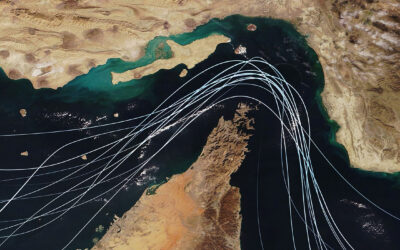
At least ten oil tankers are now ablaze or sunk in the Strait of Hormuz, a critical chokepoint that accounts for more than 20 percent of global oil flow. Commercial shipping has fallen to almost nothing. On Thursday, Iran allowed a Chinese-flagged tanker through the strait, and the United States has offered insurance and naval escort for other vessels in the area, but shipping companies and captains are understandably reluctant to run the risk, triggering a 90 percent drop in traffic.
Further west, Iran’s Houthi allies in Yemen are restarting their efforts—suspended after last year’s Gaza ceasefire—to interdict shipping through the Bab el-Mandeb, the chokepoint at the southern end of the Red Sea. The Houthis also appear to have launched missiles into Saudi Arabia, which has also been hit by rockets from Iran itself.
Also, this week, a Russian-flagged oil tanker was attacked in the western Mediterranean by a Ukrainian sea drone. Ukrainian attacks continue against Russian ships in the Black Sea, underscoring the connection between conflict in Europe and the newly-opened front in the Middle East.
On land, there is no sign yet of U.S. or Israeli ground troops entering the war, though Israeli aircraft have begun targeting Iranian internal security forces such as the IRGC and its paramilitary arm, the Basij, which might be used to suppress an uprising. U.S. media are reporting CIA plans to arm and support Kurdish separatists against the regime. Kurdish leaders have denied this, even as Kurdish troops in Iraq are massing on the Iranian border, and there are unconfirmed reports of conflict inside northwestern Iran.
Other dissident groups—the anti-regime democracy movement, and ethnic separatist Arab, Azeri and Baluch—suffered severely in January’s regime crackdown but might move against the government if the conflict continues. Such efforts will almost certainly fail unless these groups receive arms and support from external players. Pakistan, which shares a border with Iran and is allied with Tehran’s regional rival Saudi Arabia, is committed to a war against its own former proxy, the Afghan Taliban, but could join in if the war escalates further.
If a ground war does develop, it may look something like the invasion of Afghanistan in 2001, when intelligence and special warfare teams worked with Afghan allies on the ground, combining with U.S. airpower to overthrow the Taliban in less than seven weeks.
Conventional US ground forces are politically problematic for U.S. President Donald Trump, given deep scepticism among his MAGA base about foreign wars, American casualties and Israeli intentions. On the other hand, CIA or special operations teams—given their small numbers and low profile—are seen as less risky, easier to justify, and thus the preferred option.
As in Afghanistan, the question for any ground campaign is what comes next. The potential for full-scale civil war inside Iran, accompanied by state fragmentation and a region-wide flood of refugees, was on the minds of diplomats and intelligence officers with whom I spoke this week, even as the conflict’s future remains unclear. Taking down the regime is one thing; standing up a stable successor is entirely another, as any Iraq or Afghanistan veteran knows. Many leaders are clearly concerned about this.
All of this makes the current conflict more than just a third Gulf War. Countries that escaped previous conflicts are now suffering direct attacks, upending regional relationships as governments scramble to protect their populations. Closure of the Strait of Hormuz involves superpower interests and the global economy much more than previous rounds of conflict. The longer the war lasts, the greater the risk that it escalates even further, pulling more countries in.
Broader responses have been mixed. European countries—following inter-allied controversy earlier this year over U.S. threats to seize Denmark’s autonomous territory in Greenland—have expressed reservations, as has the European Union. The United Kingdom offered defensive support only, prompting President Trump to criticize British Prime Minister Keir Starmer as ‘no Churchill’ and complain that the special relationship is not what it once was. Trump announced ‘total suspension’ of trade with Spain after Madrid blocked U.S. aircraft from using Spanish bases for the attack. French President Emmanuel Macron declared the U.S.-Israeli attack in violation of international law and called for a return to negotiations, while the UN said it had seen no evidence of ongoing Iranian nuclear weapons programs. On the other hand, NATO secretary-general Mark Rutte expressed support for the operation.
U.S. adversaries Russia and North Korea—both of which have close relationships with Iran—strongly condemned the attack. China did so too, but so far has offered rhetorical support only. This somewhat surprising, since China is a major weapon supplier to the regime in Tehran and announced, days before the U.S. attack, that it was sending offensive and defensive weapons to Iran. Under a 25-year agreement signed in 2021, China also accounts for 80 percent of Iran’s oil exports and depends heavily on traffic through the Strait of Hormuz and the Red Sea. China has been stockpiling oil for several years, so Chinese leaders may calculate they can afford to wait, letting U.S. stockpiles of bombs and missiles be depleted as the war goes on. Alternatively, they may be scrambling to catch up with a rapidly-evolving situation. Neither Moscow nor Beijing has yet moved to mediate or resolve the war.
Against this background, military lessons are already emerging. AI has dramatically accelerated the targeting process, with the campaign running on a continuously-updated dynamic engagement matrix rather than a traditional daily task order. Satellite communications are ubiquitous, with small Starlink antennas seen mounted on American Low-Cost Unmanned Attack System (LUCAS) drones, themselves an improved copy of Iran’s own Shahed-136 drone, the export version of which played a prominent part in Russia’s arsenal in Ukraine.
Beyond showing how adversaries copy each other’s battlefield technologies, the LUCAS drones illustrate how important space systems such as Starlink now are. Space has now emerged as what the military calls a ‘warfighting domain’ alongside air, space, sea and cyberspace. GPS spoofing and jamming, as all sides interfere with each other’s navigation satellites, has been particularly noticeable here as in Ukraine, with knock-on effects for civilian ships, aircraft, and infrastructure. Attacks on data centres, including three Amazon Web Services data centres hit by Iranian drones in the Emirates, underline the vulnerability of AI and cyber systems to physical attack.
The war’s rapid spread outside Iran’s vicinity emphasizes how modern conflicts, irrespective of causes, rarely remain geographically contained. Regional proxies—Hezbollah and the Houthis, but also pro-Iranian militias in Iraq, Iranian-sponsored sleeper cells in western countries, and the possibility that resistance groups may play the leading role in any ground campaign—emphasize how even the most conventional conflicts involve irregular warfare, with non-state armed groups operating on their own or advised by specialist operators.
At the strategic level, one lesson is that, irrespective of President Trump’s need for a quick resolution to the conflict, lest it undermine his support ahead of critical mid-term elections in November, war is inherently complex and non-linear, unleashing forces that can neither be predicted nor controlled. Even now, the campaign is illustrating the impossibility of doing regime change from the air, to say nothing of whether regime change is even a viable goal: twenty years of the War on Terror would suggest not.
One thing I heard whispered in Washington this week was that—between Venezuela, Greenland and now Iran—others may be concluding they cannot trust American negotiators. The terms of any deal seem increasingly contingent on political whim in the White House, rather than consistent policy, and attacking a counterparty mid-negotiation makes it less likely that adversaries will themselves negotiate in good faith.
One congressional staffer gloomily told me this week that, under this administration’s force-based approach to international relations, diplomatic consistency carries less weight, but that won’t always be the case. Russia and China are watching this conflict closely, she noted, and if they see an opportunity to move against western interests while the US is tied down in Iran, credibility with allies will matter again, fast. The broader potential for escalation—for Gulf War Three to become World War Three—is not in the forefront of anyone’s mind at present, but the risk is real.
For Australia, the implications of the current conflict are stark enough. As a globally-connected trading nation, with millions of Australians overseas and massive exposure to the global system, Australians’ safety and our nation’s prosperity can easily be disrupted by events thousands of miles away. Just one illustration of this is petroleum imports, which despite rapid growth in renewables still drive almost every aspect of our economy.
The latest Australian petroleum statistics, from December 2025, showed Australia with 50 days net import coverage, 25 days of diesel consumption, enough jet fuel for 20 days, and enough automotive petrol for 26 days. In other words, if global oil supplies are interrupted for more than three to four weeks, Australia’s transportation and production systems start grinding to a halt. The government has rightly advised against panic hoarding, but fuel resilience will become a real issue as the conflict drags on.
There is also the possibility that an expanded conflict might lead to a spike in terrorism risk. Iranian-sponsored terror cells aside, unrest among or against Iranian, Jewish, Kurdish, Arab and other communities is a real issue, one that many western governments are watching, Australia almost certainly included.
A final possibility is that, if the war drags on or escalates, Australia and other allies might receive a U.S. request for support. Intelligence, surveillance and reconnaissance—including joint facilities in Australia—are almost certainly already involved. No request for warships, aircraft or ground troops has been publicly discussed, but planners would be wise to be thinking ahead.
In the meantime, and much more importantly, families like my friend’s—across Iran, Israel, the Gulf States and elsewhere—are sheltering in basements, comforting their kids, hoping they have enough food, water, cash and medical supplies, and worrying what the future holds. Tens of thousands of Australians and other expats are stranded as they seek to leave the region, and millions more locals have no exit in sight. This war is unlikely to end soon, but it has already changed the game.